PAYMENT BY
OUTCOMES TRIAL

Australia’s first federally funded trial proving jobs-focused social enterprises can deliver stronger employment outcomes for people facing complex barriers to work.

decorative

PROVING THAT SOCIAL
ENTERPRISE WORKS

The Payment by Outcomes Trial (PBO3) was Australia’s first federally funded trial of outcomes-based funding for jobs-focused social enterprises. 

Delivered in partnership with the Department of Social Services, the trial ran from July 2022 to March 2026 and involved 17 jobs-focused social enterprises across Australia. 

For the first time, jobs-focused social enterprises were paid for the employment outcomes they create, recognising the sustained employment and tailored support that are central to their model. 

Independent evaluation by the Centre for Social Impact Swinburne found  participants experienced stronger employment and wellbeing outcomes. 

Independent economic analysis by Taylor Fry found jobs-focused social enterprises outperformed Disability Employment Services across key employment measures and projected lower long-term costs to government. 

A LANDMARK TRIAL

years

3

social enterprises

17

impact investors

3

people supported into real, paid employment

132

outcome payment pool

$ 3.8 m

The trial continues 

Following the original three-year trial, PBO3 has been extended through to March 2027.  

The remaining program funding is supporting a new enrolment period involving 18 jobs-focused social enterprises and 58 participants, with a refined milestone structure. The participating organisations include returning social enterprises alongside new participants, including the program’s first Tasmanian social enterprise. 

The results presented on this page relate to the original three-year trial. The extension will be independently evaluated following its completion.

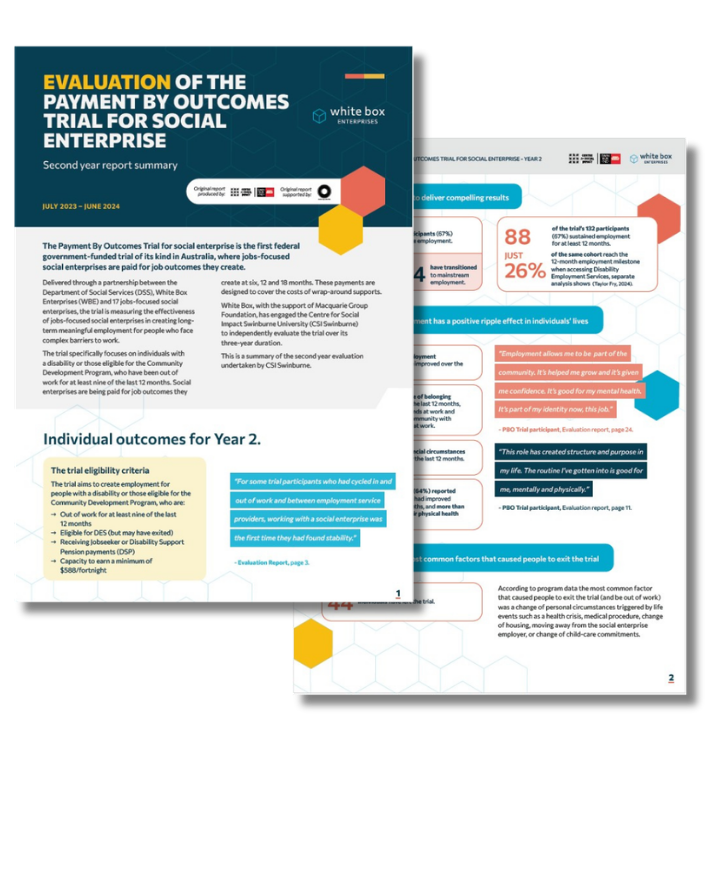
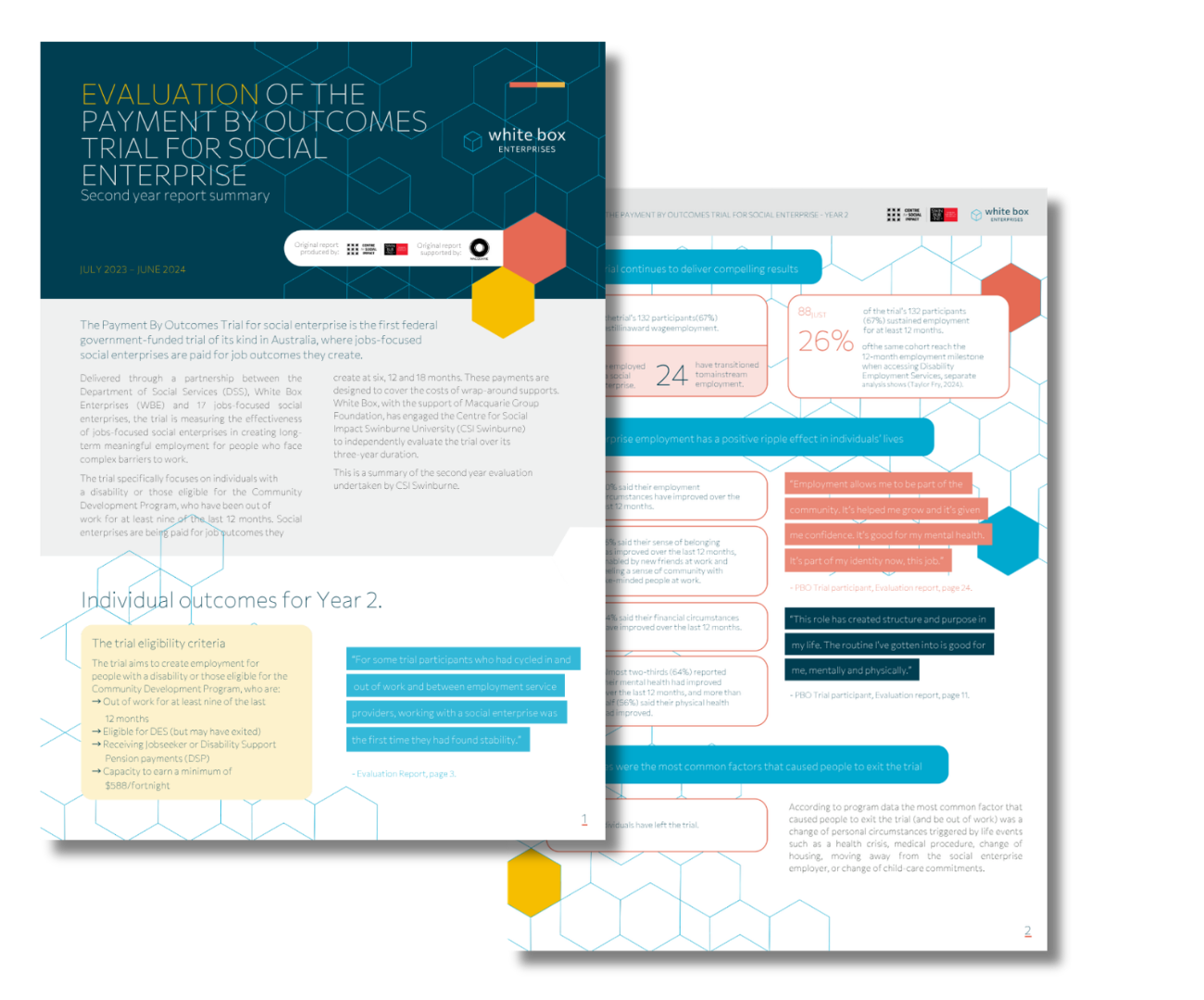
Pages from the evaluation report of the Payment by Outcomes Trial for social enterprise

What the trial uncovered

The trial enabled an independent comparison between jobs-focused social enterprises and Disability Employment Services (DES). Taylor Fry found jobs-focused social enterprises delivered stronger employment outcomes for people facing complex barriers, while projecting  lower long-term costs to government. 

Participants stayed in work longer.

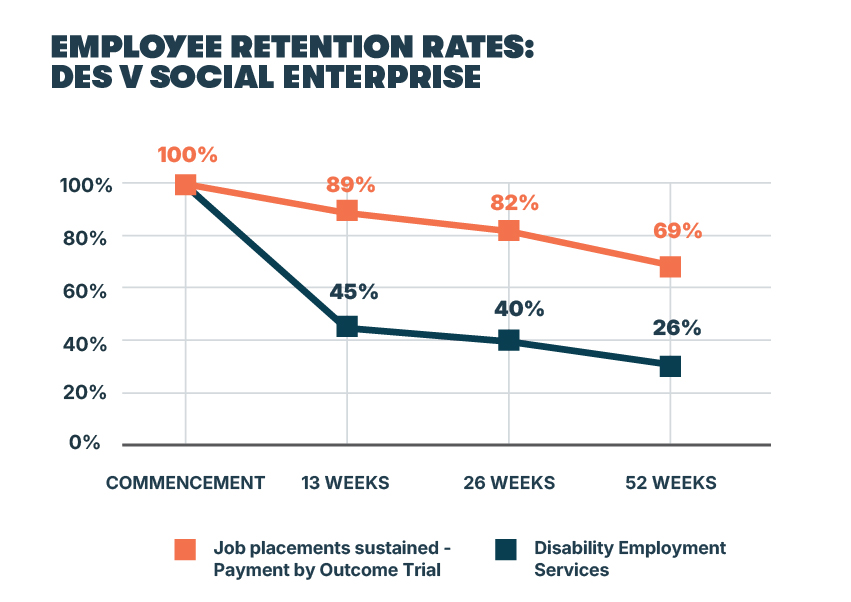
69% of participants remained in work after 52 weeks, compared with 26% through DES.

Earned more.

Participants earned $17,000 on average in their first 12 months, compared with $3,050 through DES. 

Started earning sooner.

Participants earned an award wage from day one, with training delivered on the job.

Cost government less.

Taylor Fry projected the model would cost 20% less than DES over five years.

Chart comparing employee retention: social enterprises in the Payment by Outcomes Trial keep far more people in work at 13, 26 and 52 weeks than Disability Employment Services

“If this outcomes-based model were to be scaled to 10K individuals, this could save government an estimated $220M over five years.”

Taylor Fry Report, 2024

Employment milestones achieved

Outcome payments were made when participants reached agreed employment milestones, based on how long they stayed in work and how much they earned.

reached the first employment milestone (13 fortnights in work).

76 %

reached the second employment milestone (26 fortnights in work).

45 %

reached the first transition milestone (13 fortnights in competitive employment).

13 %

reached the second transition milestone (26 fortnights in competitive employment).

11 %

More than half of all participants remained employed at the end of the trial.

remained with their social enterprise

26 %

transitioned into roles with other employers

26 %

BEYOND THE NUMBERS:
Employment delivered more than a job.

Independent evaluation by the Centre for Social Impact Swinburne found participants experienced improved financial wellbeing, greater confidence and self-belief, better mental health and wellbeing, and stronger social connection and belonging.

“Having work shows that I am doing something, and that has an effect on my mental health. If you aren’t doing anything, you feel stagnant.” 

Lia, transitioned to new employment

“I’m doing a lot better, not just with the whole work side. I’m able to do things on my own, and I’m not having my anxiety try and stop me.” 

Kade, transitioned to new employment

HOW IT WORKED

What was PBO3?

PBO3 was Australia’s first federally funded trial to pay jobs-focused social enterprises for the employment outcomes they create. It ran from July 2022 to March 2026.

The Department of Social Services, Whitebox, three impact investors, and 17 jobs-focused social enterprises. PBO3 was co-designed by these partners to test a new way of funding sustained employment outcomes for people facing complex barriers to work.

People aged 16 to 59 who had been unemployed for at least nine of the previous 12 months, were receiving government income support,  and were eligible for Disability Employment Services or the Community Development Program.

The Department of Social Services contracted Whitebox to manage the trial. Whitebox distributed outcome payments to  participating social enterprises when agreed employment milestones were achieved.

Social enterprises earned payments when a participant reached milestones of 13, 26, or 39 fortnights of continuous employment, with a further two payment milestones when they transitioned into competitive employment. These payments were designed to cover the intensive, tailored wrap-around support that jobs-focused social enterprises provide to help people gain and sustain employment.

Impact investors helped design the funding model and provided the upfront working capital that made the trial possible. Because  government payments were only made after employment outcomes had been achieved, their investment enabled social enterprises to  deliver support while waiting for outcome payments. The trial also generated practical lessons that are informing future impact investment  in the sector.

Whitebox acted as the program aggregator, managing relationships between government, impact investors and participating social  enterprises. The model reduced transaction costs and let capability and knowledge be shared across the whole sector. It also meant smaller social enterprises could take part, organisations that might not have had the resources to manage a direct government contract on their own. With a bird’s-eye view of the project, Whitebox was able to drive its overall success.

WHY WAS THIS TRIAL SO SIGNIFICANT?

PBO3 provides one of Australia’s strongest evidence bases on the role jobs-focused social enterprises can play in creating employment opportunities for people facing complex barriers to work. Its findings show that outcomes-based funding can support sustained employment while providing practical lessons for designing future employment programs and funding models.

What we learned

PBO3 demonstrated that outcomes-based funding can work for jobs-focused social enterprises. It also showed how future funding  models could be strengthened. 

The trial shifted the conversation from what jobs-focused social enterprises cost to the value they create through sustained employment  outcomes. At the same time, it showed that outcome payments need to better reflect the true cost of delivering intensive, tailored support, and that milestone structures should be flexible enough to reflect the varied employment journeys of people facing complex barriers to work. 

Our analysis also showed that jobs-focused social enterprises created value beyond what the funding model recognised. Participants were employed for an average of 42 fortnights over the life of the PBO (over 50% continued to work), but only 20 fortnights met PBO3’s earnings thresholds for payment. This demonstrates that jobs-focused social enterprises continued supporting people beyond the milestones recognised by the funding model. 

Beyond participant outcomes, PBO3 strengthened the capability of participating social enterprises. Organisations built new expertise in delivering wrap-around support, supporting transitions into mainstream employment, and working within an outcomes-based funding model. 

Finally, the trial demonstrated the value of collaboration. The aggregator model reduced administrative complexity, enabled smaller organisations to participate, and created opportunities for government, social enterprises, impact investors and intermediaries to learn together and refine the model over time. 

data talks

We’re strengthening our case for social enterprise with data so Australia’s key decision makers can see just how valuable these businesses are to individuals, our communities and the economy.

HOW SOCIAL ENTERPRISE
COMPARES

We engaged Taylor Fry in 2023 to compare social enterprise with Disability Employment Services.

The results are extraordinary:

2024 TAYLOR FRY
REPORT

An updated report comparing social enterprise with Disability Employment Services.

The findings present a compelling case for social enterprise to play a more permanent role in our national employment services system.

FINAL CSI
EVALUATION

CSI Swinburne completed its final independent evaluation of the PBO Trial.

Final report coming soon.

Year 2 CSI
Evaluation

CSI Swinburne completed its second year independent evaluation of the PBO Trial.

This is what they discovered:

YEAR 1 CSI
EVALUATION

CSI Swinburne completed its first year independent evaluation of the PBO Trial.

This is what they discovered:

PARTICIPATING SOCIAL ENTERPRISES

The trial involved jobs-focused social enterprises from across Australia.  

Ability Enterprises
Australian Spatial Analytics (ASA) logo
AbilityWorks Australia
Cleanable
Dismantle
Fruit2Work
Good Sammy
Green Collect
Hotel Etico Blue Mountains
Jigsaw
Joii
Kalan Enterprises
YMCA ReBuild
SevGen
STREAT
Clean Force Property Services
yourtown

Impact investors 

PBO3 was the third Payment by Outcomes trial launched under the Australian Government’s Social Impact Investing agenda, and the only one of the initial three trials to include impact investors.

The upfront investment provided participating social enterprises with the funding to cover wraparound support costs while participants worked towards employment outcomes, before outcomes-based payments were received.

Thank you to Macquarie Group Foundation, Tripple, and Hand Heart Pocket Foundation. This trial would not have been possible without your support.

Hand Heart Pocket, the charity of Freemasons Queensland
Macquarie Group Foundation
Tripple

Interested in future outcomes funding opportunities?

Are you a jobs-focused social enterprise interested in accessing future outcomes-based funding programs?

Register your interest to stay informed about upcoming opportunities from Whitebox.

Latest PBO Trial News

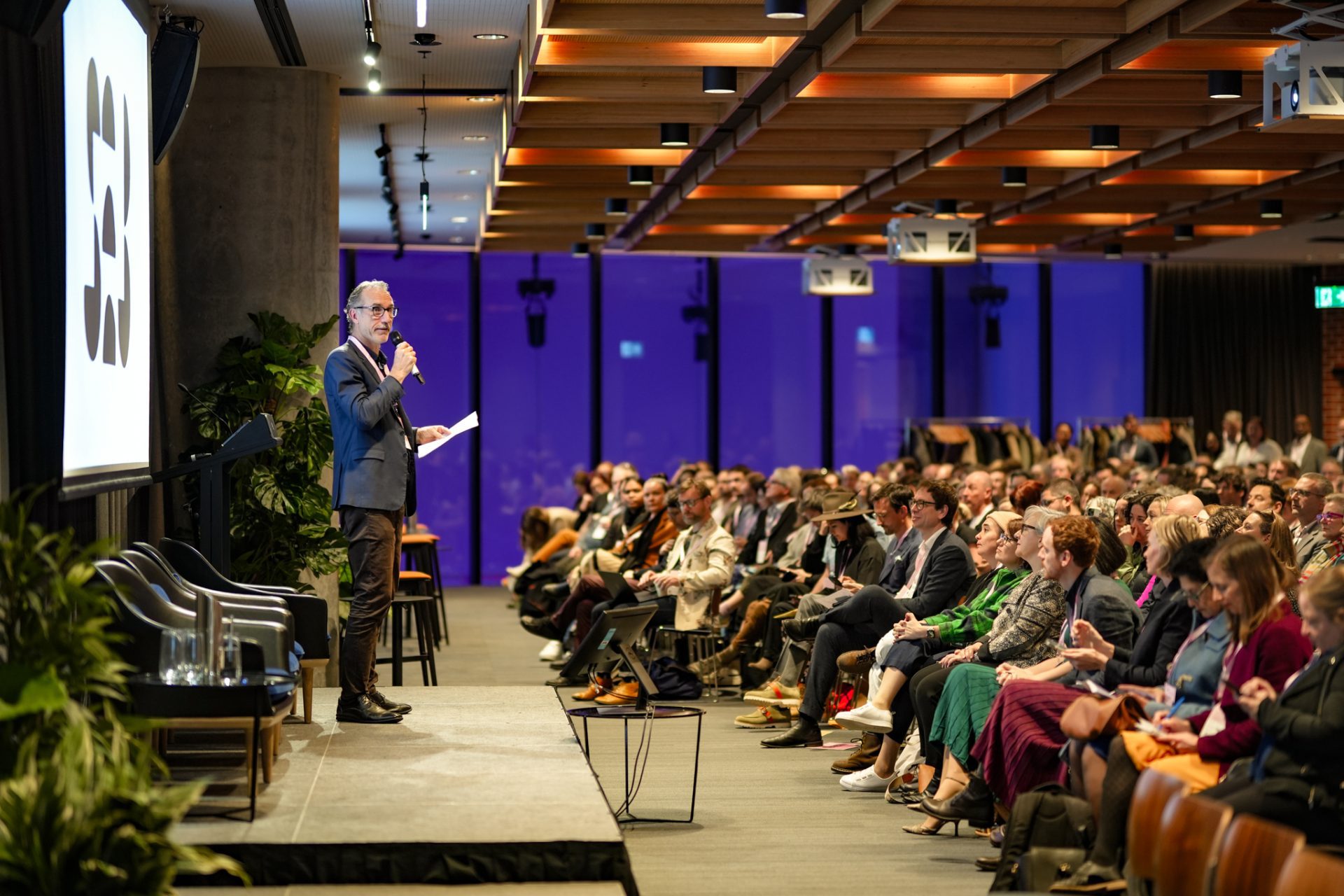
Mark Daniels opening the 2025 Social Enterprise Jobs Summit, hosted by Whitebox and Social Enterprise Australia.

Advocating through action

Whitebox is working hard to ensure both state and federal levels of government increase their understanding and support for jobs-focused social enterprise. Learn more about our advocacy plans in 2026.
Cover of the Year 2 Evaluation of the Payment by Outcomes Trial report

New report backs social enterprises as key to long-term employment success for jobseekers with complex barriers.

Whitebox has released its second year independent evaluation of the federal government Payment By Outcomes (PBO) Trial.
Front cover of Y2 PBO Evaluation Summary

PBO – Year 2 CSI Evaluation

Read CSI Swinburne's independent Year 2 evaluation of the Payment by Outcomes Trial.
image of a report cover for Taylor Fry 2024 Report

New data shows social enterprise delivers better outcomes for long-term unemployed.

As the federal government considers an overhaul of its national employment services system, Whitebox Enterprises has released a new report that presents a strong case for social enterprise to be an integral part of the solution.
decorative

ADVOCATING THROUGH ACTION

We advocate for change by doing. We build the evidence through testing and trialling with the sector. Then we share what we learn with government, philanthropy and other key influencers.

decorative

STAY CONNECTED

If you’re a jobs-focused social enterprise, join our database so you’re the first to know the latest updates and opportunities for jobs-focused social enterprises.