
WHY WE EXIST
Everyone deserves the chance to work. Jobs-focused social enterprises are making this possible.

THE POWER OF EMPLOYMENT
Work is more than a pay cheque – it provides a sense of purpose and dignity, as well as connection, confidence and routine.
Many people are locked out of work because of entrenched disadvantage and complex barriers. These include long-term unemployed individuals, people with disability, refugees, ex-offenders, and those experiencing mental health challenges.
The problem isn’t a lack of potential or willingness to work – it’s that most workplaces aren’t designed to provide the support, flexibility, and understanding these individuals need to succeed.
That’s where jobs-focused social enterprises come in.
These businesses, also known as Work-Integration Social Enterprises (WISEs), are built to do things differently. They exist to create jobs for people who are overlooked, while also contributing to the economy.
They offer unique supports that come with higher costs, but the impact is worth it. When people are employed in a social enterprise they stay in work longer, communities are stronger, and government saves money in the long run.
It’s why we’re on a mission to mainstream these businesses, and their best practices.
It’s not a level playing field when
it comes to getting a job
Only 12.9% of Workforce Australia participants are employed after 6 months. (This is the main federal government program that exists to help people back into work).
Less than 50% of working-age people with a disability are employed (This number hasn’t changed for almost 30 years).
Only 26% of people whose primary disability is mental health-related are employed.
Just 6% of refugees have a job six months after they arrive in Australia, and less than 25% of refugees have a job after two years.
60% of people who re-offend are unemployed at the time of that offence. (In Victoria, the reoffending rate drops to 12% if a person finds a job.)
The average unemployment rate for young people (aged 15-24 years) is 9.5%, 2x the national unemployment rate.
The national employment services system works for some, but not all
- $2B invested annually in Workforce Australia
- 720K people supported
- 20% of people have been in the system for 5+ years
- 12.9% six month retention rate for people supported
Workforce Australia is the country’s largest employment program, administered by the federal government. It works for some, but not everyone. It sits alongside the Department of Social Services Inclusive Employment Australia program (formerly Disability Employment Services).
In May 2026, the Department of Employment and Workplace Relations announced plans to overhaul Workforce Australia – naming social enterprise as part of the solution. Whitebox and others in the sector are working hard to ensure the reform process delivers the best outcomes for the people it’s designed to support.

“The longer you've been unemployed, the harder it is to get a job. Around one-third of employers are less likely to employ a person if they have been unemployed for 4-6 months. This proportion increases to half for those unemployed for 7-12 months, and to two-thirds for those unemployed for 1-2 years.”
Source: Australian Government, Working Future: White Paper on Jobs and Opportunities (September 2023).
Social enterprise
is the solution
WHAT ARE JOBS-FOCUSED SOCIAL ENTERPRISES?
Jobs-focused social enterprises, also known as WISEs (Work-Integration social enterprises) are businesses that exist to create jobs for people who face barriers to work.
WISEs deliver social and economic returns by creating meaningful, supportive jobs that help people move forward in life.
There are two main models. The first combines paid employment with on-the-job training and wrap-around support, giving people the time, trust and opportunity they need to build confidence and thrive in employment.
The second focuses on pre-employment training, placing people into roles in mainstream workplaces, and then providing post-placement support to help them stay in the job and keep building on their progress.
who do they support?
WISEs exist to support individuals with complex and intersecting barriers including, but not limited to:
- People who have experienced long-term unemployment
- People with disability
- People with mental health challenges
- People who’ve spent time in the criminal justice system
- People experiencing homelessness
- Refugees and humanitarian entrants
- New migrants and CALD communities
- First Nations people
- Neurodiverse people
- Youth at risk
- Women experiencing domestic violence
WHY ARE THEY EFFECTIVE?
Jobs-focused social enterprises are purpose-built to support people back into employment. These businesses take a holistic, people-centred approach to employment. They meet people where they are at, and work to overcome the barriers that are holding individuals back from meaningful employment.
WISEs offer unique supports including:
- On-the-job training and skill development
- Judgement-free recruitment processes
- Personalised development plans
- Help with things like housing, mental health, and life admin.
This kind of wrap-around support helps people build confidence, skills, and stability.
What are the costs associated with a WISE?
WISEs incur costs that standard businesses don’t. These are known as ‘impact costs’.
Dr Libby Ward-Christie, Director at the Centre for Social Purpose Organisations (CSPO) at Melbourne Business School, and fellow researchers at the Centre for Social Impact at Swinburne University, have spent the better part of a decade working with WISEs to pin down where these costs actually show up.
Their research shows that for WISEs, there are three key types of material impact costs, namely:
- Employee costs
- Property costs
- External training costs
These are further broken down into 11 categories, including things like coaching and on-the-job supervision, accessible workspaces, external training and support, transport, insurance, and equipment.
You can read more about impact costs in this news article.
The proof
is in the data
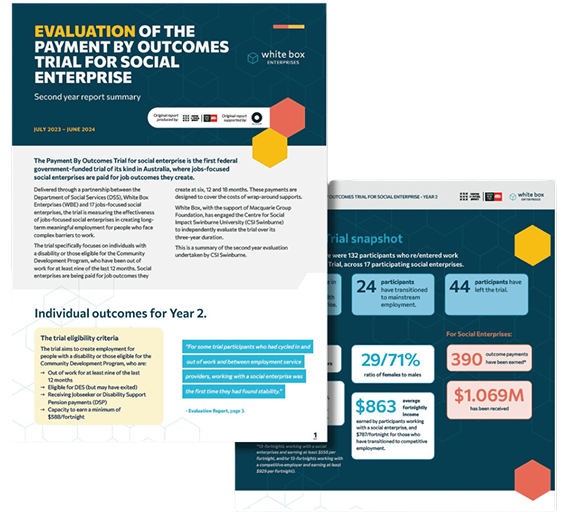
We evaluate our work, so funders, policymakers and those who are only just discovering jobs-focused social enterprise can see its impact.
SUPPORT US
Help us grow the jobs-focused social enterprise sector through funding, philanthropy or in-kind support.
SECTOR ENGAGEMENT
We’re active contributors to the conversation on jobs-focused social enterprise and we stay connected to our peers through sector research, committees, and events.