

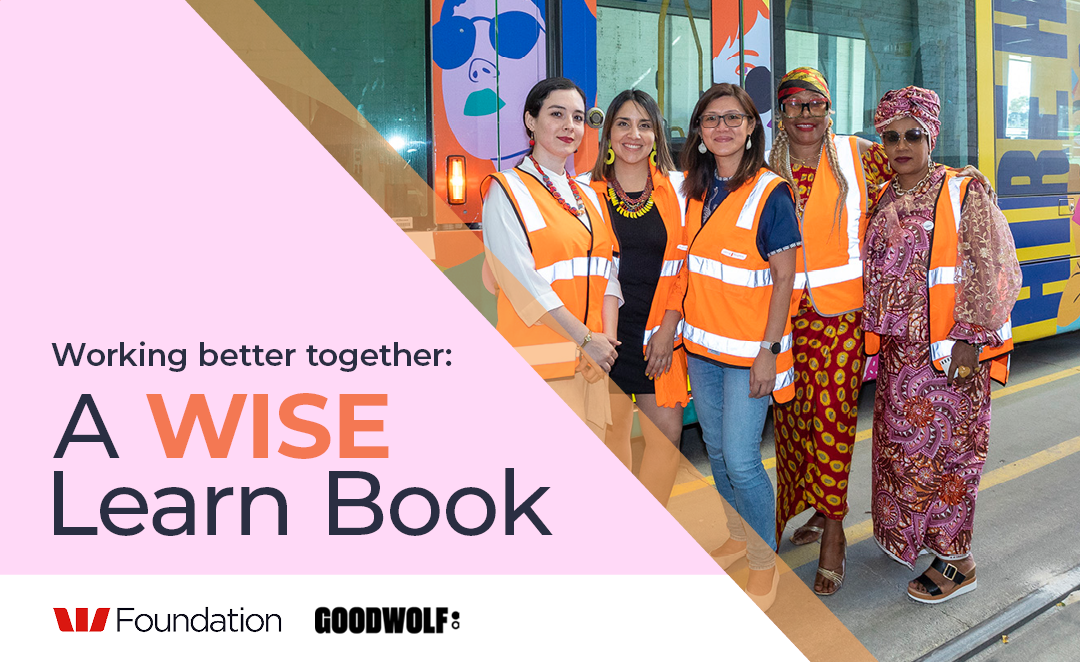
It’s not often the sector gets a 20-year reflection on what it takes to fund Work Integration Social Enterprises (WISEs) well. But a new Learn Book from Westpac Foundation does exactly that.
Drawing on two decades of funding, partnerships and sector-building, it distils what has been learned from supporting close to 90 social enterprises and investing more than $34 million into the field.
It serves as a practical resource for funders, not just a reflection, with detail on everything from assessing enterprise readiness through to how support evolving needs over time, alongside 10 key insights.
Explore the full Learn Book resources:
But what stands out most is how the report challenges some of the assumptions that still shape how funding flows to jobs-focused social enterprises today.
If you want the outcomes, you have to fund the costs
One of the clearest messages in the report is also one of the most persistently misunderstood.
WISEs carry impact costs that traditional businesses do not. These relate to the wrap-around supports required to create and sustain employment for people facing complex barriers to work.
These costs are fundamental to delivering outcomes but are rarely recoverable through trade alone.
This raises a broader system question, one the report surfaces but the sector has not yet resolved: who should be responsible for funding these costs over the long term?
In practice, philanthropy has often stepped in to fill the gap. But there is a strong case for government to play a more significant role in funding impact costs over time, particularly as WISEs remain largely outside formal employment systems. The Payment by Outcomes trial, delivered with White Box Enterprises and social enterprises across Australia, offers a practical example of how government could fund WISEs for the jobs outcomes they create.
In this context, the report points to a dual role for funders:
- continuing to fund impact costs in the short to medium term
- while also helping to shift the system settings so those costs are more appropriately recognised and supported over time.
In the meantime, the implication is clear: if impact costs are not explicitly funded, they don’t disappear, they are absorbed, deferred, or quietly erode organisational resilience.
Sustainability doesn’t remove the role of philanthropy
The report challenges a deeply embedded assumption: that “successful” WISEs should eventually become self-sustaining through trade.
In practice, sustainability looks different.
Rather than a fixed endpoint, it is better understood as the ability to continue delivering impact over time, supported by a mix of revenue streams. For many WISEs, that mix will continue to include philanthropy.
This is not a weakness of the model. It reflects the fact that markets rarely pay for the full cost of inclusive employment.
Reframing sustainability in this way shifts the role of funders. The question is no longer when to exit, but how to contribute to a capital mix that supports long-term impact.
It also opens the door to a broader group of funders.
As the report makes clear, funders do not need to have a specific WISE or social enterprise focus to be relevant here. WISEs deliver outcomes across youth employment, disability, justice, regional development and more. An impact lens, rather than a structural lens, makes it easier to see alignment.
Growth is not a proxy for success
Growth is often treated as a signal of success, and something to be encouraged through funding. But the report offers a more cautionary view.
As WISEs expand, particularly into new geographies or business lines, costs tend to rise before revenue stabilises. Impact costs also increase alongside delivery. The result is that growth can amplify risk.
This is where funding incentives matter. A focus on job numbers, expansion or growth milestones can unintentionally push WISEs to scale before the commercial foundations are ready, increasing risk rather than impact.
This is not an argument against growth. It is an argument for sequencing it carefully.
What the report points to is the importance of:
- growth that is demand-led and contract-backed
- strong commercial and operational foundations before expansion
- and planning for scenarios where growth does not go to plan, recognising that periods of instability, reset or even failure are part of the journey, not exceptions to it.
For funders, this requires a shift away from equating impact with scale, and toward supporting depth, quality and resilience of outcomes. It also requires sharing risk more explicitly, including planning for downside scenarios, rather than leaving organisations to absorb that risk alone.
What this all means for funders
Taken together, these insights point to a funding approach that is more aligned to how WISEs actually operate:
- Funding impact costs explicitly, rather than expecting them to be absorbed into trading models.
- Providing longer-term, flexible capital that supports planning and adaptation.
- Investing beyond programs, including governance, financial capability and leadership resilience.
- Using a broader capital toolkit, including grants, loans and guarantees where appropriate.
- Sharing risk more openly, including planning for downside scenarios.
They also point to the need for stronger, more transparent relationships between funders and WISEs, grounded in a shared understanding of what it takes to deliver impact, and to a more active role for government over time, particularly in recognising WISEs as part of the employment system and funding them accordingly.
WISEs are already delivering strong employment outcomes for people facing the greatest barriers to work. The question is no longer whether the model works, but whether the way it is funded reflects what it actually takes to deliver those outcomes.
In sharing these insights openly, Westpac Foundation leaves the sector with something valuable: not just a record of what’s been learned, but a picture of what needs to shift.