

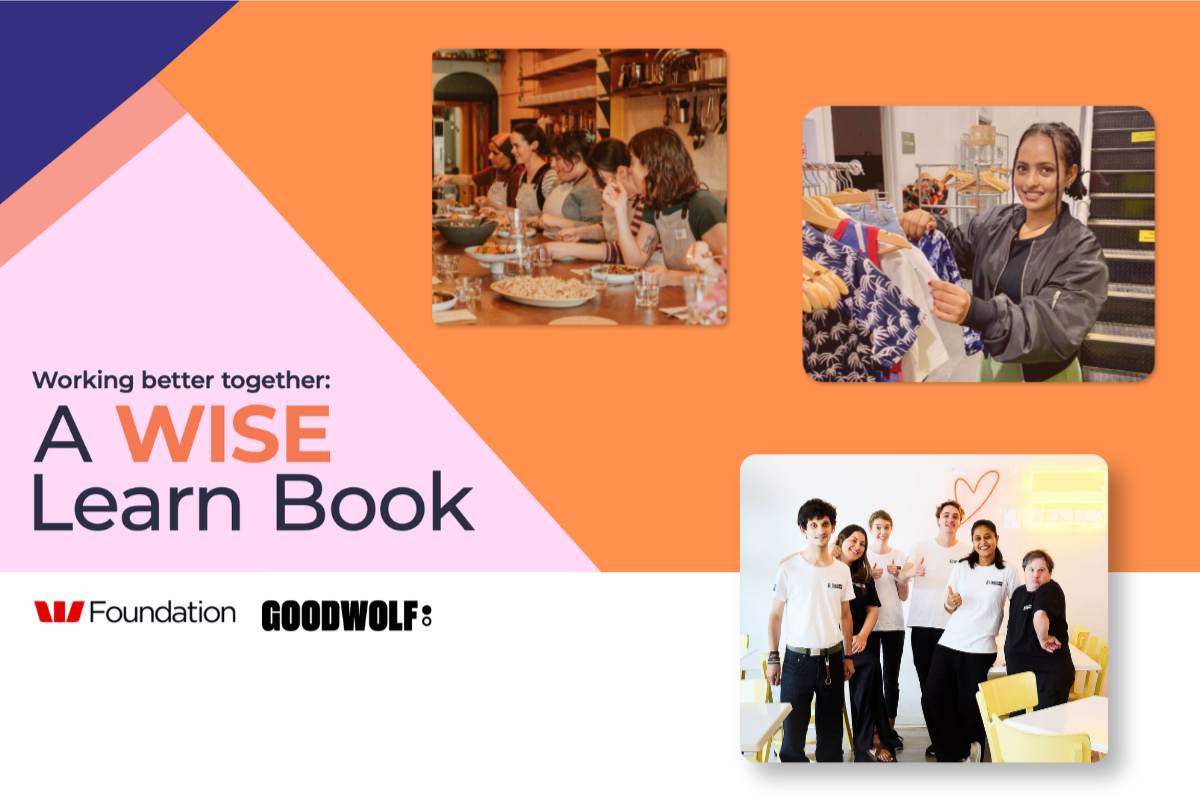
Westpac Foundation’s WISE Learn Book brings together two decades of experience funding and working alongside social enterprises across Australia.
For many WISE leaders, much of it will feel familiar. What’s valuable is that it connects the dots across those shared experiences, using real examples and case studies to highlight patterns that often only become clear in hindsight. It’s also a good reminder that many WISEs are navigating the same challenges.
You can explore the full Learn Book resources here:
Here are five key takeaways for WISEs highlighted in the Learn Book and accompanying case studies.
1. Plan conservatively, not optimistically
There can be pressure to present best-case scenarios, whether to funders, partners or Boards. The Learn Book makes the case for doing the opposite.
Scenario planning, understanding your impact costs, and modelling realistic, including worst-case, forecasts are critical to building trust and making good decisions. Conservative planning isn’t about lowering ambition. It’s about protecting the organisation and creating the conditions for sustainable impact.
Across examples such as Green Collect, a consistent theme is that volatility is normal. The organisations that navigate it best are the ones that plan for uncertainty, rather than assume it away.
This creates a stronger basis for conversations with funders, helping set expectations early and avoid pressure to pursue best-case growth scenarios.
2. Grow in response to demand, not aspiration
Growth is often expected, whether by funders, Boards or the organisation itself. The Learn Book encourages a more considered approach.
Expanding into new geographies, cohorts or business lines increases complexity and cost. When growth is driven by aspiration or external expectations, rather than real demand, risk can escalate quickly.
The experience of Australian Spatial Analytics shows both sides of this. Expansion can create significant opportunity, but also exposes organisations to new operational, financial and market risks.
A key takeaway is to test before you commit. Feasibility work, including demand testing, margin analysis, operational capability and scenario modelling, can help ensure new footprint follows secured revenue, rather than assuming revenue will follow footprint.
It also highlights the importance of planning for scenarios where growth falls short of expectations. Discussing downside scenarios upfront, including what support is available if demand or contracts do not materialise, can reduce pressure on organisations to manage wind-back or recovery alone.
This can help WISEs push back on growth expectations that are not grounded in demand.
The takeaway is not to avoid growth, but to sequence it carefully. Growth that is demand-led or contract-backed tends to be more stable and more sustainable over time.
3. Strong foundations matter
Governance, financial capability and leadership resilience can often feel secondary, especially early on. The Learn Book makes it clear they’re not.
Strong, independent Boards are critical when you’re navigating the complexity of running a WISE, particularly where organisations are balancing multiple priorities, risks and competing pressures. When governance is misaligned, it can quickly drain leadership capacity and amplify challenges.
The experience of Dismantle highlights how governance misalignment, combined with funding uncertainty and operational shocks, can escalate into significant organisational stress. It shows how important financial capability is in navigating these moments.
The Learn Book also brings attention to something talked about less often: the cumulative impact on leaders. Repeated cycles of crisis, restructuring and uncertainty take a toll. As one reflection puts it, each crisis draws down a finite reserve of energy, judgement and capacity.
What can look like overhead is often what determines whether a WISE, and its leadership, can keep going.
4. Commercial viability is part of the impact equation
WISEs operate at the intersection of mission and market. As any social enterprise leader will know, balancing the two can require difficult trade-offs. But the Learn Book reinforces that commercial viability is not in tension with impact, it is what sustains it.
The experience of Free to Feed highlights how delivering high-quality employment and support outcomes comes with real costs that are not always recoverable through trade alone, requiring careful pricing, cost management and a mix of revenue sources.
There will be moments where prioritising the business, whether through pricing, cost control or contract choices, is necessary to protect the organisation’s long-term ability to deliver employment outcomes.
Without a viable enterprise, there is no platform for impact.
5. The path won’t be linear
One of the most valuable things the Learn Book does is normalises the non-linear nature of building a WISE.
Progress is rarely smooth. Growth is often uneven. Crisis, restructuring and pivoting aren’t exceptions, they’re part of the journey.
The case studies bring this to life, showing how organisations navigate cash flow pressure, governance challenges, shifting markets and changing funding landscapes.
A key insight from Green Collect is that organisational sustainability is closely tied to leadership wellbeing. Repeated pressure and uncertainty take a cumulative toll, particularly for founders.
The Learn Book also shows how experimentation is often part of building a WISE. Operating in complex, real-world markets means not every venture will succeed, and some challenges only become clear once a model meets local conditions.
Taken together, this reframes a common experience. Not everything that feels hard is a sign something’s wrong. Some of it is the nature of the work, operating in thin-margin markets, employing people facing barriers, and carrying additional support costs.
WISEs are also operating within systems that don’t yet fully recognise or fund the outcomes they deliver.
What the Learn Book offers is perspective. It helps make sense of the realities of running a WISE and surfaces patterns that can be hard to see when you’re in it.
It’s a useful resource to return to, whether in planning, in conversations with Boards and funders, or in moments where things don’t go to plan.