

At White Box, a long term goal of ours is to see jobs-focused social enterprises firmly embedded into the national employment services system. Looking to regions, like France, where this is a reality, is a great sandpit for learning and discovery. Here we take a closer look at 'Aide au Poste' - its inclusive employment model where social enterprises are paid directly for the work that do.
In Australia, we’re very familiar with job-focused social enterprises and their role in creating employment for people locked out of the labour market. Across the country, they are proving that meaningful work can change lives, and that business can be a tool for inclusion. Yet, in the absence of a supportive environment, the sector struggles to deliver impact at scale.
In contrast, France has introduced public policies which have provided an enabling environment for jobs-focused social enterprises, resulting in a vibrant and large national ecosystem. Through a program called Aide au Poste, the French Government provides a direct, structured subsidy to social enterprises to help absorb the extra costs of supporting people back into mainstream employment.
It’s a powerful example of how public policy can combine social outcomes with economic activity and how investing in inclusive employment benefits not only individuals and businesses, but government itself.
A national approach to inclusive employment
Every year, the Aide au Poste program supports around 350,000 people across France through six categories of social enterprises and disability enterprises known as Structures d’Insertion par l’Activité Économique (SIAEs – social enterprises) and Établissements et Services d’Accompagnement par le Travail (ESATs – disability enterprises), with total government expenditure exceeding €1.3 billion ($2.2 billion AUD). The categories are based on how far the people employed by the social enterprise are from mainstream work, ranging from enterprises who simply place employees into appropriate roles, through to organisations supporting people facing significant, long-term barriers including disabilities.
For the purpose of this article, we’ll focus on the category that most closely mirrors Australia’s jobs-focused social enterprise model, that is those organisations operating commercially in a competitive environment while employing people with social barriers to work, including but not limited to people experiencing long-term unemployment, refugees, First Nations people, and people experiencing homelessness.
In its current form, Aide au Poste has been running for just over a decade. It now provides support to more than 4,500 job-focused social enterprises employing close to 170,000 people with barriers to employment every year.
So what exactly is Aide au Poste?
Aide au Poste is a public payment designed to compensate social enterprises for the additional impact costs they incur to create employment for people who’ve been excluded from mainstream employment. These costs include, but are not limited to, intensive social and professional support, the need for greater supervision and training, and mentoring.
The payment is paid monthly by the French Government’s Department of Employment for every full-time equivalent (FTE) position created within an accredited jobs-focused social enterprise. The payment is valid for up to two years per person, with each job seeker referred by France Travail - the French equivalent of Workforce Australia.
Jobs-focused social enterprises can use the payment flexibly: as a direct wage subsidy, to cover the costs of training, or to fund support roles such as social workers or supervisors.
How does it work?
To access Aide au Poste funding, a social enterprise must first gain government accreditation. This accreditation typically lasts between one and three years and confirms that the organisation meets the social and operational standards required to deliver employment and support to people with barriers to work.
The level of payments received depends on how far the social enterprise’s employees are from mainstream employment:
- Those supporting people with greater disadvantage receive higher subsidies, recognising the higher cost and complexity of that work.
- Once approved, the WISE receives a subsidy for each full-time equivalent role it creates, verified monthly by government systems.
As of 2024, Aide au Poste amounts to roughly AUD $20,000 per FTE per year for commercially operating jobs-focused social enterprises, on average about 15% of their total budget, with the remainder covered by trading income. While the payment doesn’t always fully cover the additional costs of social employment, it makes inclusion financially viable. It enables French social enterprises to deliver training, wrap-around support and employment to a growing number of people annually. Since 2018, the number of people benefiting from the Aide au Poste program has increased by 38%.
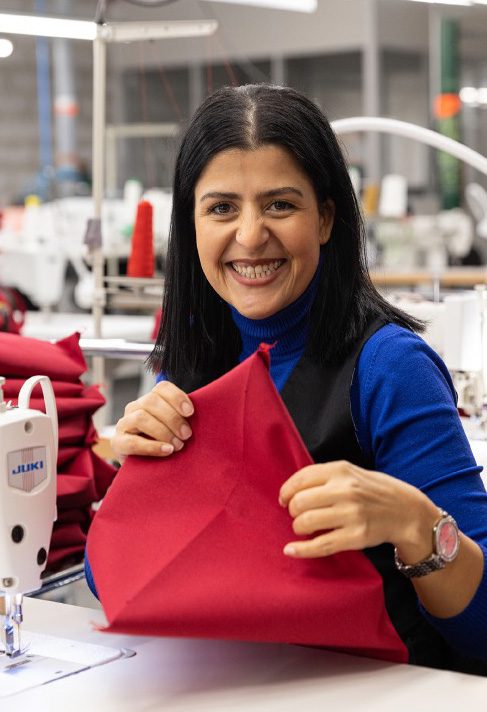
Zara, an employee of Resilience, a social enterprise in France.
Who benefits?
According to national data from DARES (the French Department for Employment Data) for the WISE category:
- 49% of participants had been unemployed for more than a year before joining the Aide au Poste program
- 77% hadn’t completed the equivalent of the Australian Year 12 certificate.
- Six months after finishing their supported role, 52% had achieved a “positive exit” - meaning that they had transitioned to ongoing unsubsidised employment or on to further training.
Aide au Poste is also a cost-saving measure for the French Government. Estimates show ongoing public savings of around AUD $11,000 per participant per year for those who had previously been long-term unemployed, including reduced welfare dependence and increased tax contributions.
Aide au Poste in practice: Resilience
An example of Aide au Poste in action is Resilience, a thriving French WISE launched at the height of the COVID-19 pandemic in 2020. When supply chains were disrupted and masks were scarce, entrepreneurs from the textile and social sectors came together to create a business making washable fabric masks locally.
What started as a crisis response has grown into a national network of inclusive textile workshops, producing a range of textile goods for customers including the Paris 2024 Olympics and a luxury fashion house.
Resilience now operates 14 workshops across the country. At its Roubaix site in northern France, 11 of 29 employees (38%) are supported through the Aide au Poste subsidy. The program enables the enterprise to employ, train and support people who might otherwise have been locked out of employment. The outcomes speak for themselves with, on average, 65% of Resilience participants transitioning to mainstream employment.
Lessons for Australia
In France, jobs-focused social enterprises are recognised as an essential part of the national employment system. They’re trusted partners in addressing long-term unemployment, with public funding designed to cover the impact costs of inclusive employment. How did they get to this point? What can we learn from their process and apply to our own approach? These are questions we are contemplating often at White Box and exploring further.
In May 2026 we'll be hosting a small discovery tour to France to better understand the integration of jobs-focused social enterprise in their national employment system and economy. If you're curious to learn more and would consider joining us, contact Nico Deloux, White Box Head of Partnerships.