

How APY Art Centre Collective used a SELF loan to strengthen their future, on their own terms and their own timeline.
When the right opportunity comes along, waiting can mean missing it.
That was the challenge facing APY Art Centre Collective (APYACC) when the chance came to open new gallery spaces in Melbourne and Sydney. A loan from the Social Enterprise Loan Fund (SELF) gave the organisation the flexibility to invest when it mattered most.
A question of timing
Owned and governed by Aboriginal-owned art centres and groups across remote and regional South Australia, APYACC exists to create opportunities for First Nations artists, strengthen cultural practice, and return value directly to communities.
Its galleries in Melbourne and Sydney connect artists working in some of Australia's most remote areas with major markets, ensuring artists receive fair returns for their work and that Anangu stories are represented on our own terms.
George Cooley, Director APY Art Centre Collective, says accessing real estate is “always a timing game”.
“Acting at the right time meant we could secure spaces in excellent locations in Sydney (Redfern) and Melbourne (Collingwood) that would allow us to significantly build our profile, create new opportunities for artists and art centres, and extend a proven model of cultural and economic impact into a new community,” he says.
The loan from the SELF enabled APYACC to fit out and open its Redfern and Collingwood galleries, strengthening its gallery network across the two cities.
“More importantly, it gave us the agility to act when the opportunities arose, rather than waiting years to accumulate capital or relying on grant cycles,” George says.
“It allowed us to make a strategic investment at the right time while maintaining ownership and independence.”
Backing themselves
Taking on debt wasn't a decision APYACC made lightly.
For many purpose-driven organisations, taking on debt feels like unfamiliar territory. APYACC explored several options before deciding on a loan, but each came with its own limitations.
Grants are competitive and often restricted, while relying solely on earned income would have significantly delayed the project.
"The loan gave us the ability to move when we needed to, while staying true to our purpose and business model," George says.
Ultimately, taking on a loan reflected a growing confidence in the business.
"It represented a shift from waiting for opportunities to be funded, to backing ourselves and investing in our future," George says.
The choice of lender mattered as much as the decision to borrow.
“As an Aboriginal-owned and governed organisation, our priorities are not always the same as those prescribed by mainstream funding or banking models,” George says.
“The loan gave us the flexibility and independence to invest in an opportunity we believed in, while retaining control over how it was delivered and ensuring the benefits flowed back to artists and communities."
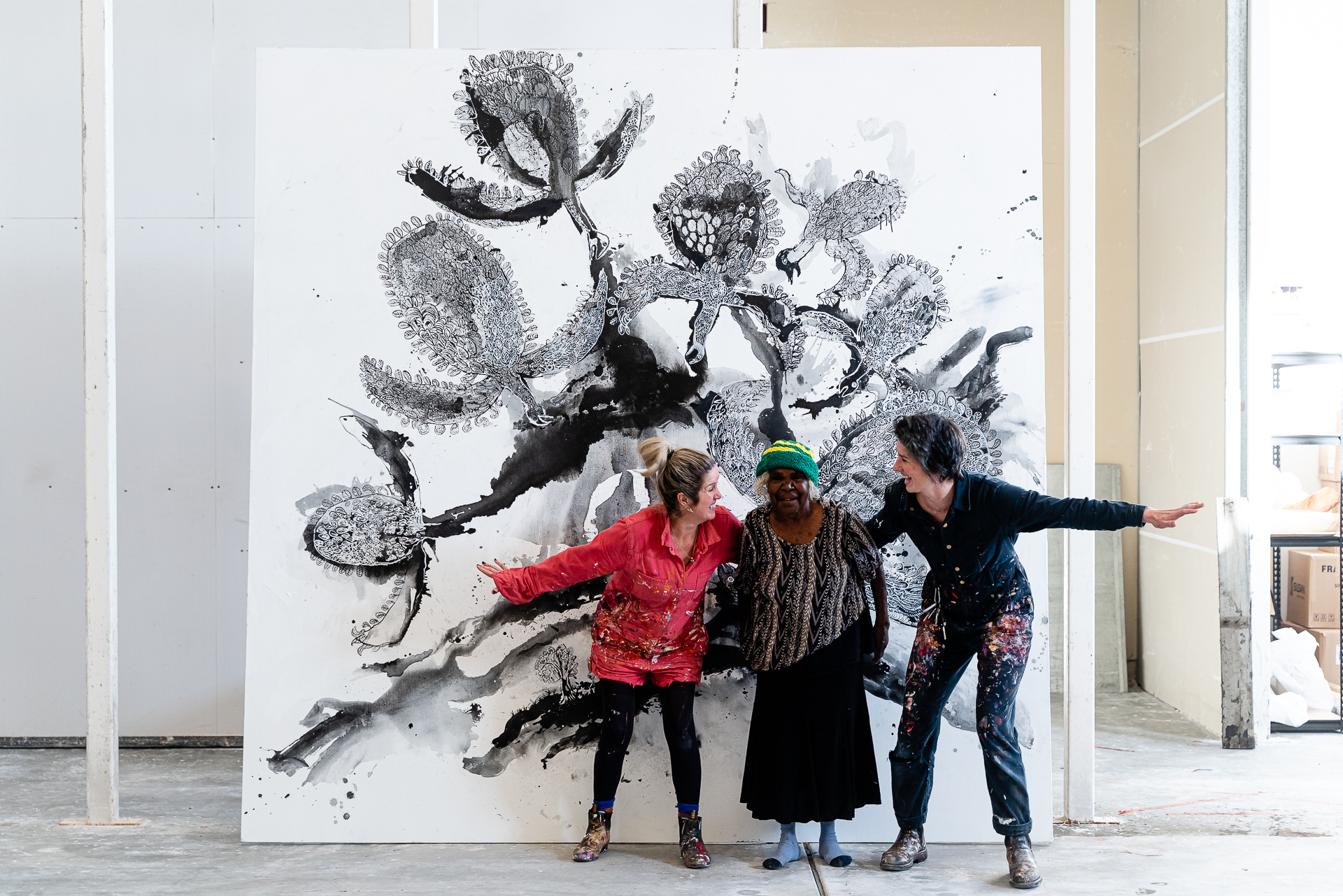
Skye O'Meara, Joanna Byrne and Illuwanti Ken in the Adelaide Art Centre.
Growing on their own terms
For George access to the right kind of finance is inseparable from self-determination.
"Self-determination requires more than good ideas. It requires access to capital,” he says.
“The right kind of finance gives Aboriginal organisations the independence and agility to make decisions for themselves, invest when opportunities arise, and build long-term economic strength.”
George says organisations like APYACC often have strong businesses and proven track records but don't sit on large reserves because income is returned to communities.
"Access to patient, values-aligned capital helps bridge that gap and allows organisations to grow without compromising their purpose,” he says.
Beyond the galleries
The Redfern and Collingwood galleries are now open. The investment isn't simply about opening two galleries. George says it strengthens APYACC's long-term ability to support artists and communities.
"It positions APYACC to shape the future of the Indigenous arts sector rather than simply participate in it,” he says.
The process also reinforced something the organisation hadn't previously tested at this scale: its own capability.
"We've learned that APYACC has the capability to manage finance as a strategic tool for growth,” George says.
“With the right capital partner, we can move more quickly, seize opportunities when they emerge, and continue building a sustainable future for artists and communities."
George’s hope is that APYACC's experience gives other organisations confidence to back themselves without compromising their purpose.
"At a broader level, it demonstrates that Aboriginal-owned organisations with strong governance, proven business models and clear community impact can successfully access and leverage capital to grow."