

What Blueline Laundry’s turnaround can teach other WISEs
Imagine picking up the phone to your biggest customer and telling them their prices are increasing by 42%.
For most social enterprises, it would be unthinkable.
For Blueline Laundry, it became the moment everything changed.
Just a few years ago, the Tasmanian commercial laundry was in financial distress. Today it is forecasting annual revenue of $24 million, employing around 250 people, with approximately a quarter of its workforce its priority cohort of people with intellectual disability, alongside employees from migrant and refugee backgrounds.
The turnaround didn't come from compromising on purpose. It came from recognising that purpose without commercial discipline isn't sustainable.
At the crux was an uncomfortable question, one that has become a mantra for Blueline and something CEO Mark Hunt believes every social enterprise should be asking.
Who are you a charity for?
Mark joined the board around three years ago and stepped into the CEO role last year. He is quick to credit much of the transformation to his predecessor, Michael Sylvester, who led the organisation through its most difficult period.
That question of who you are a charity for took hold under Michael, who joined as CEO in 2020. The organisation was already in financial difficulty when he arrived. Then COVID struck almost immediately, wiping out most of its customer base overnight. Together, those pressures made incremental change impossible.
"It became one of those moments where you couldn't muck around the edges anymore," Mark says. "It was either going to change or die."
Michael wasn't from the disability employment sector. He was an engineer.
"He looked at it as a problem to be solved," says Mark.
The numbers quickly revealed an uncomfortable truth.
"We were a charity for the Tasmanian Health Department. We were a charity for various hotel groups," says Mark. "Mike recognised that and said, 'No, that's not who we're a charity for.'"
Blueline wasn't charging enough to cover the real cost of delivering its service. In effect, it was subsidising its customers rather than investing in its mission.
The courage to charge what you're worth
That forced clarity. The most significant decision was increasing prices for a major government client by 42%, establishing a pricing floor that finally reflected the cost of doing business.
It's the sort of decision that would terrify most social enterprises. But Mark believes it was essential.
"If we're going to operate in a commercial market, then we need to behave like a commercial business," he says.
Commerciality protects purpose
The price increase was only one part of a broader reset.
Blueline fundamentally changed how it thought about NDIS funding. Rather than trying to employ as many supported workers as possible as the way to build the business, it recognised that its commercial activity needed to generate the revenue required to sustain the organisation. NDIS funding could then be used for what it was intended: providing the additional supports that enable people with intellectual disability to succeed at work.
"Our revenue base is our commercial activity," Mark says. "We then use NDIS funding to be excellent in the way we support people being part of our business."
The organisation benchmarked productivity, overheads and corporate costs against the commercial laundry industry, then made deliberate decisions about where purpose justified operating differently. Rather than apologising for governance and compliance costs, they calculated what was genuinely required and built those into the model.
For Mark, data doesn't compete with purpose. It enables it.
"I think there's a fear that being data driven means you lose your humanity. Actually, that'll send you broke,” he says. “Your head tells you what your options are. Your heart tells you which one is right."
He is also clear that good evidence isn't just numbers. For Mark, the strongest case for any decision rests on three things: solid data that shows something works, a theory that explains why it works, and lived experience that reveals where it doesn't. Each leg of that stool matters.
It's a philosophy that reflects the leadership behind the turnaround. Sylvester brought an engineer's mindset. Mark, a scientist by background, has built on that analytical approach.
Build the team your business needs
Mark believes that complementary expertise has been one of Blueline's greatest strengths.
He says that social enterprises sometimes recruit for passion before capability, while overlooking the operational skills needed to run sustainable businesses.
"You need people who understand finance. You need people who understand customers. You need people who understand the business itself,” he says. “It's necessary to have your heart in the right place. But it's not sufficient."
Blueline's leadership team deliberately combines commercial laundry expertise, finance, operations, customer relationships and disability experience. It's a mix that reflects the complexity of running both a competitive business and a social enterprise.
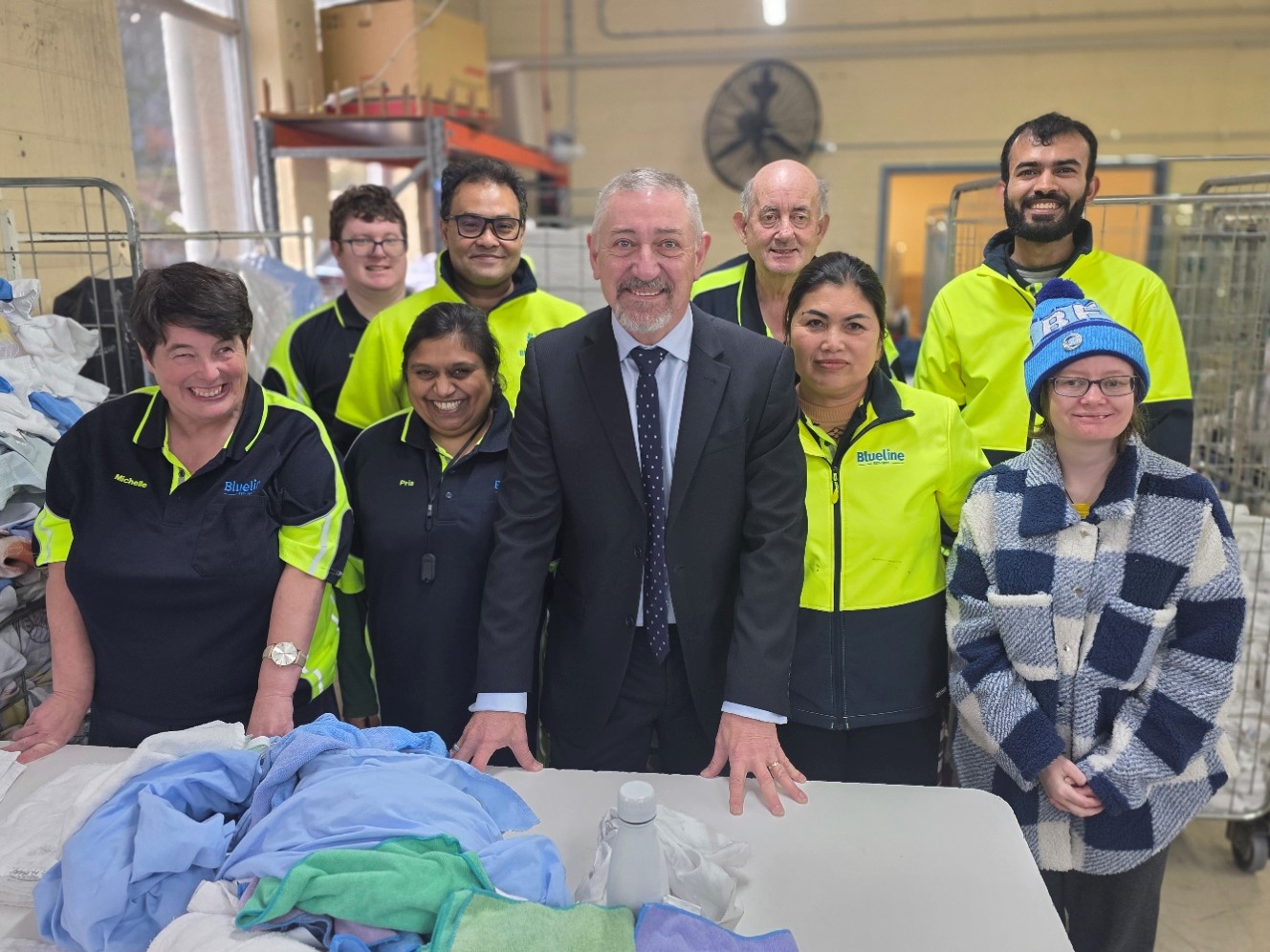
Mark Hunt with some of the crew at the Hobart laundry, including the team from the sewing room.
Mission isn't everything. Focus is.
Today, commercial sustainability is no longer what keeps Mark awake at night. The bigger question is mission.
Specifically, whether organisations are being genuinely intentional about the cohorts they exist to serve.
As Blueline has grown, so has the diversity of its workforce. Migrants and people from refugee backgrounds now make up a significant share of its employees. Mark is proud of that, but he questions whether organisations sometimes broaden their mission simply because those groups are already part of the workforce, rather than because they've made a deliberate decision to serve them.
It's a conversation Blueline's leadership team is actively having.
For Mark, if an organisation says it exists to serve a particular cohort, it should also invest in the specialist capability and support that cohort needs.
"If we're going to say we're about migrants, we need to be doing things that explicitly support their journey,” he says. “Otherwise, what are we doing that's different from Bunnings or Coles?"
He draws a clear line between being an inclusive employer and having a defined mission.
"We want to be a great employer. We want to be inclusive and supportive of everybody we can. But our mission has been people with intellectual disability. We have people who understand working with people with intellectual disability. We understand the NDIS. We've built the systems, capability and expertise to be excellent at that."
For Mark, strategy is ultimately about making choices.
"If I've only got one job, who gets it? Strategy tells me that. If strategy can't answer that question, it's not strategy. It's opportunism."
Looking beyond growth
Mark sees Blueline's journey in distinct phases, each requiring different leadership.
The first, under Michael, was turnaround: stabilise, restore profitability, build commercial scale.
Mark's role is different. Having inherited a commercially sustainable business, his focus is resilience: strengthening systems, governance, infrastructure and purpose so the organisation can withstand whatever comes next.
"We're not trying to maximise efficiency. What we want to do is maximise the likelihood that we're going to be here and sound in 20 years' time."
Only then comes growth. And for Mark, growth isn't simply about employing more people directly.
His ambition is to demonstrate that employing people with intellectual disability can be commercially viable, then use that proof to give other employers the confidence to do the same.
"If we can be a model for the business community, our impact is much bigger than the number of people we employ ourselves," he says.
For Mark, commercial discipline and social purpose are two halves of the same whole.
Getting the balance right means having the discipline to ask uncomfortable questions and the courage to act on the answers.
Who are you a charity for? And what kind of business do you need to build to sustain your purpose?
For Mark, those questions never stop. They simply evolve.
Five takeaways for WISEs
- Know who you're a charity for. Don't subsidise your customers. Price your products and services to reflect the true cost of delivery, and direct your social investment where it belongs.
- Use commercial discipline to protect your mission. Good intentions aren't a business model. Understand your costs, your productivity and your margins so your impact can endure.
- Build the team your business needs. Commercial expertise, operational knowledge, finance, customer relationships and social impact all matter. Passion alone won't build a sustainable enterprise.
- Be intentional about your cohort. There's a difference between being an inclusive employer and having a clearly defined mission. If you broaden your mission, be prepared to build the capability and supports that make that commitment meaningful.
- Remember that sustainability is the impact strategy. Long-term commercial viability isn't separate from your mission. It's what allows your mission to continue.