

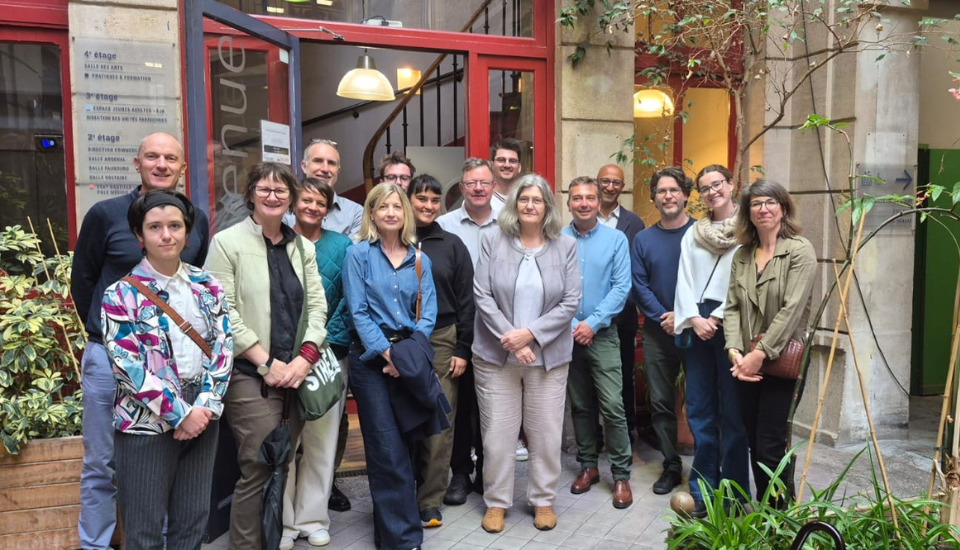
White Box recently took a delegation of Australian social enterprise leaders and funders to France to explore how jobs-focused social enterprises and disability enterprises are supported to operate at scale – and we came back with our minds blown.
If you run a WISE, you already know what the work asks of you. You are running a business that employs people who need more time and more support, while competing commercially, managing your own internal systems, and holding your organisation together. The reality is that the work is complex.
What we saw in France offered something different.
Not a perfect system, but a clear example of what becomes possible when the system is designed to support this work. It gave us a more concrete picture of what Australia could look like if it made that same choice.
What's different in France
France’s Social and Solidarity Economy (ESS) is not niche. It employs 2.4 million people - around 10% of the national workforce - operating across a broad range of sectors in competitive markets.
Within the ESS, WISEs and disability enterprises operate at significant scale. Around 4,600 WISEs support 170,000 people each year, alongside 2,600 disability enterprises supporting more than 150,000 people annually, delivering consistent pathways into work for people facing complex barriers.
What stood out was not a single policy or program. It was the coherence of the whole system.
A critical part of that coherence is definition. The French system is clear about what different types of social enterprise are, what role they play, and who they serve. That clarity underpins how support is structured, including how subsidies like Aide au Poste are applied, ensuring funding is aligned to the specific cohort and level of need, rather than treated as a one-size-fits-all model.
Underlying this is a clear recognition: social enterprise is not supported as an alternative or add-on, but because it is one of the most effective ways to create employment pathways for people facing complex barriers.
Social enterprises are embedded in employment services, procurement frameworks, funding models and workforce policy. There is a shared understanding that inclusion through work is part of the economy.
That shows up in practical ways. Impact costs are recognised and funded. Procurement creates real demand. Disability employment obligations are enforced and linked to social enterprise supply chains. Capital is more patient. The result is that social enterprises can focus on running strong businesses that create jobs.
The iceberg beneath the surface
When we observe thriving social enterprises in France, we are seeing the tip of a very large iceberg. This was a beautiful analogy from Kate Barrelle, co-founder of STREAT, who joined us on the French tour.
At the visible level, we saw large, capable enterprises employing thousands of people. But what matters is what sits beneath that.
Wage subsidies of up to €20,000 per person per year. Procurement clauses that require large businesses to source from disability enterprises or pay a levy. Multi-year government contracts that let organisations plan. A nationally coordinated employment system that handles referral, assessment and transition, so enterprises can focus on running a business.
And beneath that again are the deeper assumptions: that inclusion through work is core economic infrastructure, that government has a role in enabling it, and that the cost of inclusion should be visible and shared.
“In Australia we have social enterprises wobbling precariously at the tip of this iceberg without the ballast of infrastructure or enabling mental models underneath.”
— Kate Barrelle, STREAT
We should be clear about what makes this hard to simply import. France’s model is rooted in a political tradition where the state plays an active role in social and economic life, and where solidarity is embedded in institutions, not just rhetoric. The Social and Solidarity Economy has legal definition, decades of policy history, and cross-party support behind it.
Australia starts from a different place.
That is not a reason to abandon the vision, but it is a reason to be clear-eyed about the work required to build toward it.
Why this matters for WISEs in Australia
For many WISEs, the French model explains a feeling that is well understood but rarely named.
It shows up in the day-to-day reality of the work. Running a business while also designing employment pathways, providing support, managing transitions, and holding everything together when the system around it doesn’t.
In Australia, these roles sit with the enterprise.
In France, many of them sit within the system.
That difference matters. It reduces risk, creates clarity, and makes it possible for enterprises to focus on what they do best; running strong businesses that create jobs.
It also changes the experience on the ground. Inclusive employment is not treated as a special program. It is part of how the economy works.
A system lever in practice
One of our most striking days was spent at the Stade de France, hearing how the Paris 2024 Games embedded social procurement at the heart of its operations.
More than 600 social enterprises secured contracts worth over €800 million, woven directly into the supply chain for the Games, not bolted on as an afterthought.
This did not happen by chance. It was enabled by a dedicated backbone function that connected social enterprises to procurement opportunities and supported them to compete at scale.
For Australia, Brisbane 2032 presents a similar opportunity. Not as a one-off initiative, but as a deliberate system lever to create demand and build capability across the sector.
This is the focus of GoodSupply 2032, a collaboration between White Box, QSEC, Social Traders, SEFA, Yunus Sports Hub and the English Family Foundation. The initiative is designed to maximise procurement opportunities for social enterprises in the lead-up to the Games, embedding social impact directly into the Brisbane 2032 supply chain.
This is a systems question
It is tempting to look for elements of the French model that could be adopted immediately. Better procurement. Wage subsidies. Clearer definitions. All of these matter, but on their own, they are not enough.
What we saw in France is the result of a system that has been intentionally designed over time. The strength comes from how the pieces work together, not from any single lever. Replicating that is not a programmatic challenge. It is a systems change challenge. And that will require government.
At its core, this means government taking a more active role in holding the cost and risk of inclusion.
What WISEs can take from this
The opportunity is not to replicate France. It is to understand what sits beyond the constraints of the current system, and to use that picture to anchor what we are working towards.
The French model shows what is possible when the system is fully enabled: enterprises operating at scale, stable and predictable revenue, clear employment pathways, impact costs recognised and funded, and inclusion embedded in mainstream economic activity.
That vision matters. Not because it can be replicated tomorrow, but because it sharpens how we engage with government, funders and partners.
It also reinforces something important. Social enterprise is not the problem to be fixed. In many cases, it is already doing the work.
France did not build its social enterprise sector by accident. And it did not ask enterprises to carry the system on their own. It built the conditions that allow them to operate, grow and deliver.
In Australia, WISEs are already doing extraordinary work under pressure. The question is not whether they can do more. It is whether we are willing to build what sits beneath them.
Because the difference between a fragile sector and a thriving one is not effort. It is the system it sits within.